
Loan management for Philippine HR teams.
The PRIMIS employee loan and payroll deduction module helps Philippine HR and payroll teams review company loans, repayment estimates, schedules, and external deductions.
Example monthly time savings
500-employee example with 150 active loans and two pay runs: assumed minutes saved across the company on 120 request lookups, 60 repayment-estimate reviews, 300 collection checks, and 60 external statement updates per month.
- Loan request lookups
- 20 hrsper month10 min saved × 120 lookups
- Repayment reviews
- 15 hrsper month15 min saved × 60 reviews
- Collection checks
- 25 hrsper month5 min saved × 300 checks
- Statement updates
- 15 hrsper month15 min saved × 60 updates
Keep repayments clear. Check the balance.
An external lender's statement and payroll collections can show different balances. PRIMIS keeps official statement evidence separate from the estimated collection balance, helping HR review what remains before the next deduction.

Know the obligation. Before the deduction.
Review what was requested, what the employee receives, and what must be repaid. Keep those amounts beside the loan's approval and disbursement history.
-
Find the request
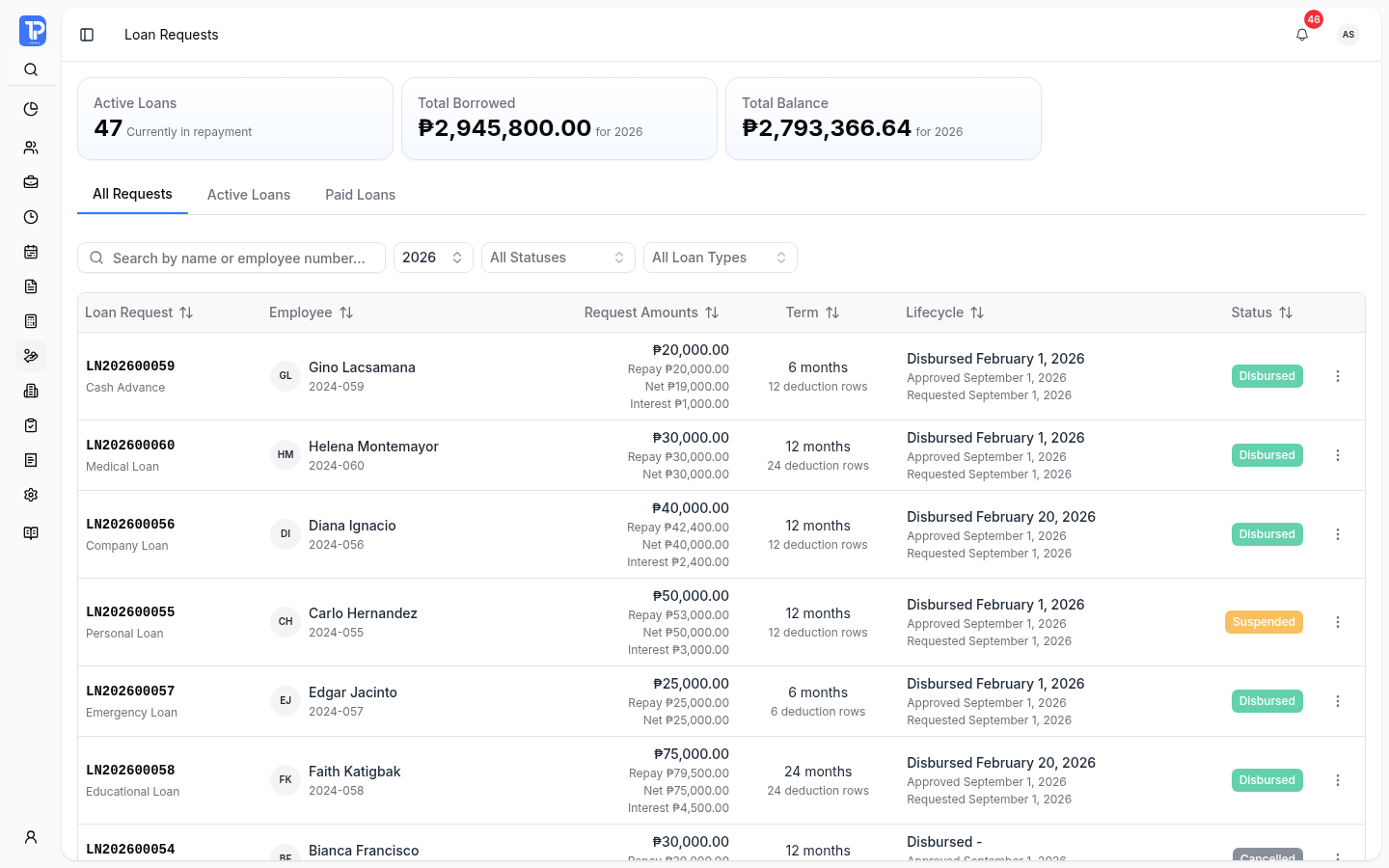
Search by employee name or number and filter by year, status, and loan type. Keep principal, repayment, net disbursement, interest, term, and lifecycle dates together.
-
Follow the balance
Active Loans shows remaining balances and collection progress. Paid Loans keeps completed accounts in a separate view.
-
Open the supporting details
Review the approval flow, attachments, request context, and repayment detail from the loan record.
Set the terms. See what payroll would collect.
Company-loan templates give HR reusable limits and repayment rules. The estimate makes those rules visible before an authorized decision.
A repayment estimate
- Principal / net disbursement
- ₱30,000.00
- Interest on principal
- 0.5% × 12 months = ₱1,800.00
- Total repayment
- ₱31,800.00
-
Template rules
Configure principal limits, available terms, minimum tenure, interest method, upfront interest treatment, and an optional monthly deduction cap.
-
Repayment estimate
Review total interest, net disbursement, total repayment, and the estimated amount per cutoff. Payroll frequency splits collection; it does not change the template's interest method.
-
Approval and disbursement
Follow the configured approval flow. Marking an approved loan as disbursed generates its repayment schedule and deduction rows.
The preview is an estimate, not an active repayment schedule. Repayment-risk guidance supports human review and does not approve or reject a request. Template changes apply to future requests; existing loans retain their approved terms.
Keep external deductions separate. Keep the lender evidence visible.
Manual Loan Deductions records an obligation to an agency, bank, cooperative, or other lender. It has its own collection policy and statement evidence.
-
Collection and stop rules
Set monthly amortization, start month, payroll scope, and allocation. Choose a balance-based or fixed-period end policy; an amortization amount alone does not establish the end date.
-
Official and estimated balances
Record the official statement balance with its date, source, and reference. Payroll collections update an estimated collection balance; they do not replace newer evidence from the lender.
-
Exceptions and final pay
Review collected and skipped activity. Record outside-settlement or statement-update context when payroll cannot collect. Final-pay deductions depend on the selected policy, balance evidence, and available pay.
Explore payroll processing and final pay
Only active external deductions with a matching payroll scope are collected. Loan Management requires Core and may be included in a configured plan or enabled as an add-on. Actions and template access remain permission-controlled.
Questions about Loan Management
Repayment estimates, approved terms, statement-led balances, and access.
The request preview is an estimate. Marking an approved company loan as disbursed generates its repayment schedule and deduction rows. Payroll frequency splits collection without changing the template's interest method.
No. Company-loan template changes apply to future requests; existing loans retain their approved terms. External deduction templates also provide defaults for new records rather than rewriting existing deductions.
No. An external deduction retains its official statement balance, date, source, and reference. Payroll collections update an estimated collection balance. HR records newer lender evidence separately, and final-pay handling depends on the selected policy, balance evidence, and available pay.
Loan Management requires Core and may be included in a configured plan or enabled as an add-on. Loan, template, approval, disbursement, and external-deduction actions depend on permissions and record state. Confirm your organization's entitlement with PRIMIS.
Connect loan administration to payroll.
Discuss your employee-loan, external deduction, repayment, approval, and final-pay requirements with PRIMIS.