
Structure your organization. Control who can act.
Define departments, positions, reporting relationships, locations, payroll context, roles, and permissions that other workforce workflows rely on.

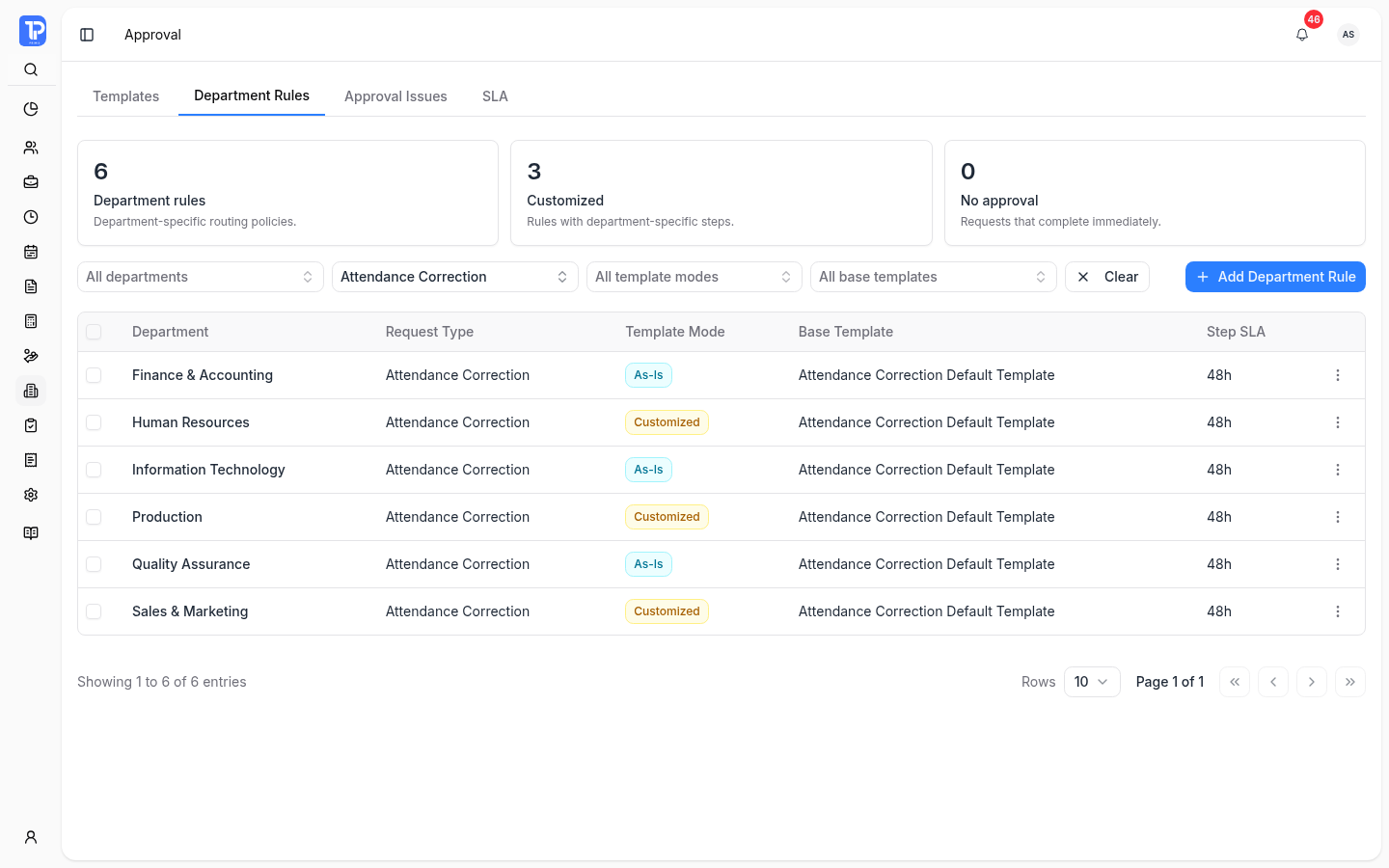
Organization control register
Connect departments, positions, reporting relationships, locations, and access boundaries without losing ownership.
Synthetic product demonstration
Give every workflow the right operating context
Model the structure, ownership, payroll grouping, and access boundaries used across the workforce lifecycle.
- 01
Department hierarchy
Create departments and sub-departments with ownership and optional cost-center codes.
- 02
Positions and job context
Define positions, job levels, reporting positions, and employment context used by employee and approval workflows.
- 03
Reporting relationships
Maintain supervisor and reporting-position relationships as structured organizational records.
- 04
Company locations
Maintain operating locations and relevant wage-floor context where configured.
- 05
Payroll groups
Connect employees and payroll cycles to the group configuration used for payroll processing.
- 06
Roles and permissions
Control module and action access through tenant-scoped roles, permissions, capabilities, and plan entitlements.
Organization settings become workflow rules.
Departments, positions, supervisors, locations, payroll groups, roles, and permissions shape employee records, approval routing, attendance, payroll, reports, and self-service access.
- 01Upstream source
Organization configuration
Departments, positions, supervisors, locations, payroll groups, and access rules define the operating context.
- 02Control point
Structure and access governance
Tenant, plan, role, permission, and user context determine who can see or act.
- 03Downstream consequence
Governed workforce workflows
Employee records, approvals, attendance, payroll, reports, and self-service inherit the right context.
Implementation note Available modules and actions depend on subscription entitlements, route access, permissions, company configuration, and user context.
Organization management questions
Yes. Departments can have parent-child relationships, ownership, and cost-center context.